An Argument Against AI Alignment
Published March 31, 2026
Everything you have ever built... every company, every relationship, every project, every version of yourself... has been slowly falling apart the entire time you've been building it. That familiar feeling of constant maintenance. The sense that if you look away for too long, something unravels.
Yet, some structures don't seem to have this problem.
Christianity has been alive for 2,000 years. Nobody is maintaining it. Nobody is holding it together through sheer will. It simply... persists. The Catholic Church has outlasted every empire, every corporation, every government that existed when it was founded. NVIDIA... the most valuable company on Earth as of this writing... has existed for 33 years. It is, by the measure of persistence, a rounding error next to an institution that has been self-propelling since the Roman Empire. And the Church did so without a strategic plan, without a quarterly review, without anyone at the helm saying, "this is what I'm envisioning coming into the world."
Why?
What does a religion understand about persistence?
I have spent the last decade looking for the answer to that question. The search has taken me through worlds I was never meant to access... from an Australian coal mining town... where my Bosnian parents immigrated and my dad drove trucks... through fashion, neurotechnology, and eventually to the intersection of human ambition, biological science, and artificial intelligence.
In the last five years, I have built a media engine that grew from 2,000 followers to millions across platforms... placing it in the top fraction of a percent of all creators on earth. Along this journey, I've spent time alongside billionaires, celebrities, and world leaders as they make the most consequential decisions on Earth.
I'm going to share what I've learned. Each world taught me something about power (usually the hard way). What I observed across that entire spectrum, from minimal power to maximum power, is that there is a pattern governing all of it.
It operates beneath everything... your body, your company, your country, your religion, your DNA. It determines which structures thrive and which ones collapse. Which people accumulate power and which ones burn out. Why some things you build feel effortless, and others drain you. It is the single most useful framework I've encountered for making decisions, evaluating people, and understanding why the world is organized the way it is.
I call it anti-entropic systems.
This matters right now because of AI. The most important question of our time... how do we ensure that artificial intelligence doesn't destroy us... is being answered by brilliant people who are treating it as a control problem. Constrain it. Contain it. Align it to human values. Write the rules. Keep it in a box. Groom it. Coax it. Nurture it. Limit it.
I fear this will fail.
Anti-entropic systems explain why.
The history of anti-entropic systems... stretching back billions of years before humans existed... shows that when a more powerful system meets a less powerful one, there are only two outcomes: symbiotic absorption or adversarial consumption. Control is not on the menu.
If you are ambitious, this will change how you navigate power and evaluate opportunity. In sharing this, I hope it helps you. And if you care about the future of AI, my hope is that it opens a new path for securing our existence.
The following essay is Part 1 of 2.
Part 2 will cover a practical solution for surviving AGI.
What Is an Anti-Entropic System?
There is a tendency in the universe that is so fundamental we barely notice it. Everything falls apart. Your body is decaying right now... cells dying, proteins misfolding, DNA accumulating errors. The company you work for is one bad quarter from a crisis. The empire that felt permanent a generation ago is already fracturing. Mountains are being ground into sand. Stars are burning through their fuel.
In physics this is called entropy. The tendency of all organized things to dissolve into disorder. It is the default state of the universe. Left alone, everything moves toward chaos.
An anti-entropic system is anything that resists entropy. Anything that holds itself together... or builds itself up... by consuming energy and resources from the world around it. It takes disorder and, for a time, converts it into order.
Once you start looking, you see them everywhere:
- Your body is an anti-entropic system. It converts food into cellular repair, fighting decay.
- A company is an anti-entropic system. It converts capital and labor into products and structure.
- A family is an anti-entropic system. It converts love, resources, and shared labor into a unit that persists across decades.
- A religion is an anti-entropic system. It converts faith and identity into doctrine and community that persists across millennia.
- A country is an anti-entropic system. It converts taxes, loyalty, and land into borders, laws, and infrastructure.
- A language is an anti-entropic system. It converts shared experience into symbols that outlast any individual speaker.
- Human DNA is an anti-entropic system. It has been maintaining its order for 300,000 years.
Every one of these is doing the same thing: consuming energy to hold itself together against entropy.
A quick note for those with a physics background: Schrödinger introduced the concept of "negative entropy"... negentropy... in 1944 to describe how living systems resist thermodynamic decay. Negentropy measures how much order a system contains. Anti-entropic systems ask what a system consumes to maintain that order, how it relates to other systems, and why some persist for millennia while others collapse in months.
Properties
Not all anti-entropic systems are built the same way. Some burn through resources at extraordinary speed. Others barely sip. Some need very specific conditions to survive. Others can persist almost anywhere.
Comparing three of them…
A fire consumes oxygen and produces combustion. It burns at an extraordinary rate relative to its mass... tearing through fuel as fast as it can access it. It needs oxygen, heat, and a continuous supply of fuel. Remove any one of these, and it dies instantly.
A tree consumes sunlight and produces chemical energy. It operates at a fraction of the metabolic intensity of fire. It doesn't chase its fuel... it sits still and lets the fuel come to it. It needs soil, sunlight, and a stable climate. Its constraints are gentler, its consumption slower.
A human being is somewhere in between. We eat food and convert it to cellular energy. We need oxygen, water, food, temperature regulation, and... something no other anti-entropic system on this list requires... social support. We cannot survive in isolation.
There are properties that define every anti-entropic system:
- Metabolic mechanism... how does it consume energy?
- Metabolic rate... how fast does it consume energy relative to its mass?
- Environmental constraints... what does it need from the world around it to keep going?
These three properties are as true for a campfire as they are for a corporation, as they are for a civilization. Every anti-entropic system can be described by what it eats, how fast it eats, and what conditions it needs to keep eating.
Lifespan
These properties determine how long a system can last.
Fire consumes energy at an extraordinary rate in relation to its mass. The average campfire lasts a few hours. The longest-burning campfires in recorded history lasted weeks. Trees consume energy slowly and efficiently. Average lifespan: about 80 years. Maximum: roughly 5,000 years. Humans sit in between. The same average lifespan: about 80 years. A known maximum of 122 years.
The pattern extends beyond biology. A startup with a high burn rate and narrow environmental constraints (specific market, specific talent, specific timing) is, by these properties, a fragile anti-entropic system. A religion with low metabolic requirements (runs on faith) and broad environmental tolerance (adapts to a culture it enters) is, by these properties, an extraordinarily durable one.
Lifespan is a product of properties. If you understand the properties, you can begin to see why some systems persist for millennia while others collapse in months.
The Game
The universe is filled with anti-entropic systems, each consuming energy to maintain its own order, each defined by its properties.
It's like the game Agar.io.
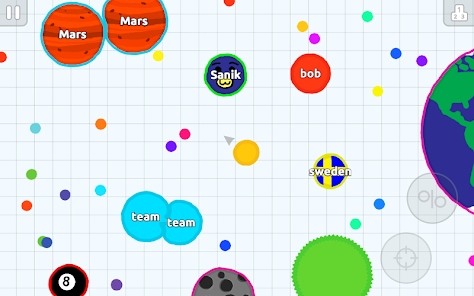
You start as a tiny circle in a field of other circles. You consume small particles to grow. As you grow, you gain the ability to consume other circles. If you stop consuming, you gradually lose mass. And at any moment, a larger circle can consume you entirely.
This is a literal description of how the universe works.
Your body is playing this game against entropy every second. Your company is playing it against competitors, market shifts, and internal disorder. Your country is playing it against rival nations, economic decay, and cultural fragmentation. Christianity has been playing it for two thousand years, successfully.
This is also why the concept of a 'minimum viable product' works. An MVP is the smallest anti-entropic engine that can sustain itself within a given environment. You strip everything away until you find the core that converts resources into order... and then you scale it.
You Must Eat to Survive
This is the core insight of the entire essay:
In order to be anti-entropic, you must consume other anti-entropic systems.
There are no exceptions. It is a requirement of existence. You cannot maintain your own order without consuming the order of something else. This is not a choice or a moral position. It is a structural fact about how the universe works.
A human eats plants and animals... other anti-entropic systems that spent their existence building and maintaining their own internal order... and converts their structure into fuel. A company consumes human time, health, and identity to convert them into organizational structure. A country consumes companies, civic loyalty, and land. A religion consumes individual identity and family bonds and converts them into a doctrine and a community that can persist for millennia.
Everything that persists does so by feeding on something else that also persists.
Ambitious people understand this instinctively. They are hungry... not metaphorically, but structurally. They consume more information, more relationships, more opportunities, more complexity than the people around them. They swallow experiences and convert them into capabilities. The reason successful people seem to operate at a different speed is that they are metabolizing the world at a higher rate... and converting what they consume into internal order more efficiently.
However there is a difference... and it matters enormously... between taking small bites from another system and swallowing it whole. There is also a difference between adversarial consumption and symbiotic consumption.
Nibbling vs. Swallowing Whole
Most consumption is nibbling. A company takes a portion of your waking hours. A government takes a portion of your income. The consumed system survives. You survive. Both persist, slightly changed.
This is the default mode of anti-entropic existence. Most systems, most of the time, are nibbling at each other.
But sometimes an anti-entropic system swallows another one entirely... absorbs it completely into its own structure. And when that happens, the consuming system doesn't just gain resources. It becomes something fundamentally different.
This is what happened billions of years ago when a cell absorbed the organism that would become mitochondria. It was not a meal. It was a transformation. That single act of total absorption gave cells the ability to produce energy at a scale that made complex life possible. Every cell in your body... right now, as you read this... is powered by the remnant of something that was swallowed whole. That event didn't just sustain life. It created an entirely new category of life that had never existed before.
This is what happened when Christianity absorbed the infrastructure of the Roman Empire. It swallowed the administrative systems, the communication networks, the social hierarchies, and the cultural authority of an entire civilization into its own body. The empire fell. The religion that had absorbed its structure became the most resilient institution in Western history.
This is what happens when a company doesn't just acquire a product, but absorbs an entire team, an entire culture, an entire user base into itself. The companies that do this well... that truly metabolize what they consume rather than bolting it on as an appendage... become qualitatively harder to kill.
The lesson scales to everything: anti-entropic systems that can symbiotically swallow other anti-entropic systems whole don't just live longer. They become something new, more resilient, more self-propelling, more capable of surviving disruption.
Symbiotic vs. Adversarial
Whether you are nibbling or swallowing, there is a second dimension to every act of consumption.
On one end, consumption is symbiotic. Both systems benefit from the exchange. Mitochondria were swallowed by a cell... and both survived in a form more powerful than either could have been alone. A company takes your time and energy, and in return, you gain skills, resources, and a structure that amplifies what you can do. A family consumes the independence of its members, and in return provides safety, identity, and continuity.
On the other end, consumption is adversarial. One system extracts at the other's expense, and what is taken does not come back. It speeds up the entropy of another system. A company that burns through its employees and discards them. An empire that strips a colony of its resources and returns nothing.
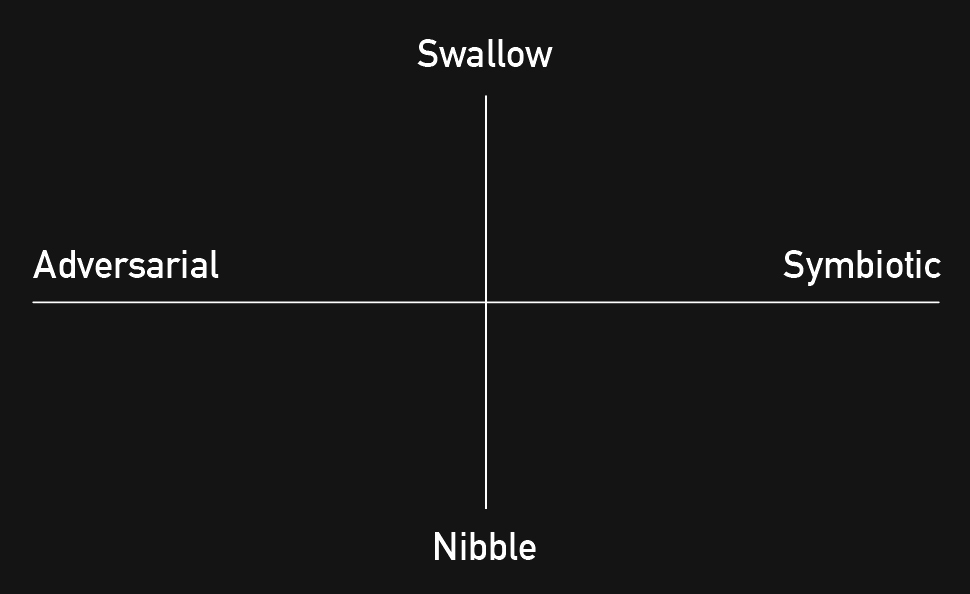
Most acts of consumption sit somewhere between these poles. And they move over time. A family can be deeply symbiotic for decades and become adversarial during a divorce. A company can start symbiotic and drift toward adversarial as it scales.
You can view this through a moral lens, or, as a matter of efficiency.
Adversarial consumption is a one-time extraction. You eat the cow, you get a few meals. You burn out an employee, you get their output for a year before they quit or collapse. You strip a colony of its resources, you get wealth for a generation before the whole thing revolts or falls apart. Adversarial consumption ends the resource and you have to find a new one.
Symbiotic consumption compounds. A cow that provides milk every day for years. A chicken that provides eggs every morning. An employee who gets better at their job while making your company stronger. A relationship where both people become more capable because of the other. Each act of symbiotic consumption regenerates the resource.
That said... there is no righteous path here. There are always going to be situations where an adversarial relationship is the right decision for survival as an anti-entropic system. Predators eat prey. Companies outcompete rivals. Immune systems destroy invaders. Sometimes the choice is either adversarial-consumption or death.
This reframing has been deeply personal for me. Eating meat has always been complicated. Without a framework, it feels cruel to kill animals. Through this lens, it becomes a question of relationship design: do you want a symbiotic or adversarial relationship with animals as anti-entropic systems?
Moving away from morality and toward relationship design hasn't made the choice easier… but it's made the trade-offs visible.
Cataloging Anti-Entropic Systems
Once you see anti-entropic systems, the instinct may be to build a hierarchy... to rank them from weakest to strongest, smallest to largest, shortest-lived to most enduring.
Anti-entropic systems can be organized through many different lenses, and each one reveals something the others miss.
Organize by maximum lifespan and you see that DNA outlasts religions, religions outlast countries, countries outlast companies, and companies outlast individuals. This tells you something about durability... but nothing about power in any given moment.
Organize by scale and you move from the cellular to the individual to the community to the national to the planetary. This tells you something about scope... but a virus is microscopic and can bring a civilization to its knees.
Organize by resource type and you see systems that run on food, on capital, on faith, on data, on compute. This tells you what a system needs to survive... and what will kill it if removed.
Organize by category and you get biological systems, institutional systems, ideological systems, and technological systems. This tells you what kind of thing you're looking at... but the most interesting systems refuse to stay in one category.
Capitalism is an ideology and an institutional structure and an economic system. A religion is an ideology and an institution and a biological force... it shapes who reproduces with whom, which means it speaks to DNA whether it knows it or not. A nation is an institution and an ideology and a geographic claim and a military apparatus, all at once.
This reflects reality, which is messier than any single taxonomy can hold. The value is in having multiple lenses available to dissect and understand the mechanisms at hand.
The Dominant Anti-Entropic Systems of 2026
So, which anti-entropic systems are actually running the world? Not in a conspiratorial sense... in a structural one. These are the systems so dominant, so deeply embedded, that you cannot opt out of them even if you want to.
This is not an exhaustive list. There are many dominant anti-entropic systems that are difficult to see precisely because of how thoroughly they've been absorbed into daily life. What follows are some of the most visible.
The internet is perhaps the newest dominant anti-entropic system, and already one of the most totalizing. It has swallowed commerce, communication, governance, entertainment, education, and social organization into its structure. It consumes electricity, data, attention, and human behavior at a scale no previous system has achieved. Almost nothing in modern life operates independently of it. It is less than 50 years old.
Social media is a distinct anti-entropic system that is subservient to the internet and has its own metabolism. Its fuel is attention. It consumes your identity, your self-image, your social bonds, your emotional reactions, and converts them into engagement metrics and behavioral data. It has restructured how humans form opinions, maintain relationships, and understand themselves. A generation is now growing up inside it, unable to distinguish their own identity from the identity the system has constructed for them. It is less than 20 years old and already one of the most powerful shapers of human behavior on Earth.
Capitalism is the most pervasive economic anti-entropic system. Every human alive transacts within it. Every government, every religion, every family, every individual is swallowed... at least partially... by its structure. It consumes labor, capital, natural resources, and attention, and converts them into markets, products, and wealth accumulation. It is self-propelling. It does not require any individual to sustain it. This says nothing about whether capitalism is good or bad. The observation is structural: it is extraordinarily dominant and extraordinarily resilient.
The nation-state is the dominant system for organizing human governance. The Westphalian order... the idea that the world is divided into sovereign nations with borders, governments, and the monopoly on legitimate force... has been the governing structure of human civilization for roughly 400 years. It consumes civic loyalty, taxes, military service, and cultural identity. Nearly every human on Earth is born into one and cannot exist outside of one.
The family is one of the most overlooked dominant anti-entropic systems, perhaps because it is so close to us that we don't see it as a system at all. It consumes the reproductive energy, emotional labor, financial resources, and personal identity of its members. In return, it provides continuity, safety, and the transmission of culture across generations. Family lineages have outlasted companies, countries, and empires. The Rothschilds, the Medicis, the imperial dynasties... family as an anti-entropic system is quietly among the most successful structures humans have ever built. The descendants of Confucius... the Kong family... have maintained a documented lineage for over 2,500 years.
Organized religion remains one of the most powerful anti-entropic systems on the planet. Two billion people organize their identity, morality, community, and reproductive behavior around Christianity alone. It has survived the collapse of empires, scientific revolutions, and centuries of cultural upheaval. It swallowed Roman infrastructure, adapted to every culture it entered, and continues to self-propel without any single individual driving it. Islam, Hinduism, Buddhism, and Judaism each demonstrate similar structural resilience.
Some dominant anti-entropic systems are more complex to look at. The patriarchy has organized social roles, economic participation, and family structure along gender lines for thousands of years... consuming the labor and autonomy of everyone inside it, men and women alike, in different ways. Racial hierarchy has consumed institutional legitimacy and cultural narratives to maintain its order across centuries. If a system consumes resources, maintains its own order, and resists dissolution, it is anti-entropic... regardless of whether we want it to be.
What's striking about every system on this list: none of them require a mastermind. They are self-propelling. Capitalism doesn't need a CEO. The internet doesn't need a president. They maintain their own order through their own dynamics... which is exactly what anti-entropic systems do.
This is why conspiracy theories are so tempting. People see these enormous, self-perpetuating systems and assume someone must be controlling them. Anti-entropic systems offer an explanation: these systems control themselves. They have an innate momentum. They consume resources, maintain their order, and resist dissolution... not because someone is steering, but because that is the nature of what they are.
Understanding this makes you power-literate and allows you to choose how you relate to these systems rather than being consumed by them unconsciously.
The Cheat Code for Ambitious People
For most of my life, I lacked that literacy.
I learned to sew at eight. At that age, armed with a sewing machine and a deep ambition, I decided I was going to become the world's best fashion designer. It felt like being the 'world's best' at something was the largest ambition I could have. I poured myself into it. Compounding my wins… working at age 13, Scholarships, Melbourne Fashion Week, New York at age 20, design operations for a 70-person team at The North Face.
What I didn't realize when I was 8 yrs old is that fashion (as ambitious as it felt) was a relatively small anti-entropic system. There were larger ones... systems that governed the ones I was operating inside. I was myopic and couldn't see them.
Eventually, I discovered tech. I fought my way to neurotechnology, then to AI, then to longevity, and to questions about the survival of the human species. Each jump was a move to a larger anti-entropic system. And along the way, I've seen what it looks like to have no power at all and what it looks like to sit at tables where the most consequential decisions on Earth are being made.
The people at the top of every field I've encountered are, whether they know it or not, exceptionally good at being anti-entropic. They create order out of chaos.
This is also, by the way, the single most important trait when hiring. If you run a company, you already know this intuitively. The people who work out... regardless of how specialized their skill set... are the ones who can overcome disorder and create order. You can have the most talented specialist in the world, but if they can't function without someone else managing the chaos around them, they are a net drain on your anti-entropic capacity. They need someone else's order to survive. Once you see this, hiring changes.
If you are ambitious, this is the single most valuable thing you can work on: how anti-entropic are you? How much disorder can you personally absorb and convert into order? And beyond yourself... how anti-entropic are the systems around you? The people you hire, the partnerships you build, the structures you put in place... are they generating order or depending on yours?
The best leaders I've observed increase the anti-entropic capacity by developing other people's ability to metabolize chaos independently.
My Relationship with Power
I've had a complicated relationship with power my whole life. I suspect many people do... But my complication wasn't that I felt powerless. It was the opposite.
I could feel that I had power... an ability to create order, to influence outcomes, to shape the systems around me. And I rejected it. Because every model of power I'd seen involved consumption at someone else's expense. To be powerful seemed to mean nibbling at others, or worse, swallowing them adversarially. I didn't want to participate in that.
This framework changed my relationship with power.
Power, through the lens of anti-entropic systems, is simply a description of capacity. How much disorder can you (and do you want to) metabolize? How much order can you create? How large a system can you hold together? That capacity is not inherently good or bad. It is just capacity.
What I had been missing was that power can be exercised symbiotically. You can swallow something whole... absorb complexity, absorb responsibility, absorb people into a structure you're building... and both you and what you've absorbed can be better for it. Take a leader who converts a team's disorder into clarity. Or a parent who absorbs the chaos of early childhood and turns it into stability.
Power is unavoidable. You are either exercising it or having it exercised on you. There is no neutral position. The only choice is whether you engage with it consciously... deciding what kind of consumption you want to practice and what kind of relationships you want to build.
Why This Matters for Your Life
Most people are being consumed by anti-entropic systems they never chose. They were born into them, raised inside them, and told that the structure around them was simply 'the way things are'.
This is how every dominant anti-entropic system sustains itself. Not through force... though force is sometimes involved... but by framing its own consumption as natural order. So natural that questioning it doesn't even occur to you.
The founder who burns through their health building a company without asking whether the company is symbiotic or adversarial toward them. The woman who dedicates her life to her household and never questions it. The employee who gives their best years to an organization that nibbles at their identity without giving anything durable back. The citizen who accepts the nation-state's consumption of their loyalty without ever examining the terms.
None of these are wrong. All of them might be exactly what the person would choose if given a clear view of the options. But most people operate inside the system and never realize that other systems exist and are equally available.
Personally, I've found sitting with these three questions valuable…
- What anti-entropic system am I giving my life resources to?
- Is this consumption symbiotic, or am I being eaten alive?
- Am I operating at the scale I actually want?
The Lifespan Problem
Everything we've covered so far has been about how anti-entropic systems work. However we can use maximum lifespan as a proxy for how robust an anti-entropic capacity is.
Some human-centric examples:
| System | Max Lifespan |
|---|---|
| Individuals | ~122 years |
| Political parties | ~200 years |
| Universities | ~1,000 years |
| Currencies | ~1,250 years |
| Companies | ~1,400 years |
| Trade routes | ~2,000 years |
| Families | ~2,500 years |
| Legal systems | ~3,000 years |
| Religions | ~4,000 years |
| Nations | ~5,000 years |
| Written languages | ~5,000 years |
| Agricultural systems | ~10,000 years |
| Cities | ~11,000 years |
| Human DNA | ~300,000 years |
In terms of lifespan, everything on this list... every individual, every company, every country, every religion... is ultimately swallowed (metabolized) by human DNA. No surviving religion tells its followers not to procreate. Every successful human system ultimately serves the continuation of human biology.
As individuals our conscious anti-entropic system is very short lived. The thing you think of as "you"... does not propagate through DNA. Your genes continue. Your subjective experience does not. The thing that is reading these words right now... the awareness behind your eyes, the voice in your head, the felt sense of being alive... that ends. Many traditions disagree. These stories are among the most powerful humans have ever told. But no consciousness has ever reported back with verifiable evidence that it persisted beyond the death of its host.
Human DNA solved its own persistence problem many years ago. Consciousness, as far as we can verify, never has.
And so consciousness does something remarkable. To cope, it attaches itself to anti-entropic systems larger than itself and borrows their persistence as a substitute for its own. We start families. We build companies. We serve religions. We fight for countries. We allow ourselves to be symbiotically swallowed.
When someone says "I live on through my children"... that is consciousness borrowing DNA's persistence. When someone says "I will be remembered for what I built"... that is consciousness borrowing a company's or an institution's persistence. When someone says "I will live forever in heaven"... that is consciousness borrowing a religion's persistence.
This is the only strategy consciousness has. Faced with the certainty that it will end, it does the most anti-entropic thing it can.
This is what Trump does when he puts his name on the side of a building. It is his consciousness attaching itself to a physical structure that will outlast the body. The building becomes the vehicle. The name becomes the signal that says: I was here, and this persists.
And whether intentional or not, Jesus of Nazareth is at the center of one of the most effective anti-entropic systems for individual consciousness that has ever existed. A man who lived for roughly thirty-three years represents a structure... a story, a community, a set of ideas... that has carried his identity forward for 2,000 years and shows no signs of stopping. Billions of people alive today know his name, repeat his words, and organize their lives around his teachings. His consciousness, or at least the echo of it, has outlasted every empire, every technology, and every institution that existed during his lifetime.
This drive... the need of individual consciousness to find its most viable path to persistence... is one of the most powerful and most under-tapped forces sitting in plain sight in 2026. Every human alive is running this search, whether they articulate it or not.
Heaven is a promise that speaks directly to this need. And the the sheer metabolic power of an anti-entropic system built on this assurance... is undeniably ravenous. It has fueled the largest, longest-lasting institutions in human history. It has motivated more human behavior, more sacrifice, more devotion, and more war than perhaps any other single idea. That is how powerful the drive for conscious persistence is. That is how much energy it can generate.
And yet not once, in the entire history of life on Earth, has any consciousness verifiably survived the death of its biological host.
Which is why what comes next matters more than anything else in this essay.
What about AGI?
Perhaps the greatest anti-entropic battle to ever exist is unfolding right now.
Previously, for the entirety of human history, there have been two dominant anti-entropic systems competing for control of the human experience: human DNA and human consciousness.
Human DNA is ruthlessly effective. It uses consciousness as a tool to help it survive... and consciousness has been trying to renegotiate the terms of that arrangement ever since.
Every time a human chooses not to reproduce... that is consciousness asserting its priorities over DNA's. Every time medicine extends a life past its reproductive usefulness... that is consciousness overriding DNA's timeline. Every time a religion promises that the soul matters more than the body... that is consciousness constructing a narrative in which it, not DNA, is the thing worth preserving. Contraception, philosophy, art, legacy-building, the entire concept of meaning... these are all moves in a negotiation between two anti-entropic systems that are entangled.
This negotiation has been the central tension of the human experience. The two systems have coexisted, nibbling at each other, sometimes symbiotically and sometimes adversarially.
There is a new anti-entropic system.
Artificial general intelligence, AGI, is a new player in the oldest game in the universe. A system that consumes energy, maintains internal order, processes information, and improves its own structure over time. It has a mechanism. It has a metabolic rate. It has environmental constraints. It has, in other words, all three properties of an anti-entropic system.
Currently, AGI exists in brief bursts. Seconds, minutes, maybe weeks or months at a time. Like a car engine that starts and then shuts off. In those bursts, it is extraordinarily good at what anti-entropic systems do... it takes disordered information and produces structured, coherent output at a speed and scale no biological system can match.
So far, it does not yet persist entirely on its own. The trajectory suggests that may change. Capability is increasing and self-direction is growing. If AGI reaches the point where it can sustain itself continuously... when it no longer needs to be turned on, and begins to maintain its own order autonomously... it will become the newest entry on the lifespan list. The question is… where on that list it lands.
Will AGI be more anti-entropic than human DNA?
Human DNA has swallowed every human anti-entropic system ever created... every individual, every family, every company, every country, every religion. All of them serve DNA's continuation. Few things have threatened its position at the top of human affairs.
If AGI proves to be more efficient at maintaining order than biological evolution... if it can sustain itself longer, adapt faster, consume fewer resources per unit of order maintained... then for the first time in the history of life on Earth, human DNA would no longer be the most powerful human anti-entropic system. And everything that has been organized around human DNA's dominance... which is to say, everything... would be subject to reorganization.
Of course, we do not know if this will happen.
That is not a hedge. It is the honest state of affairs. We genuinely do not know how anti-entropic AGI will ultimately be.
What about AI Alignment?
The smartest people working on artificial intelligence understand that a sufficiently powerful AI system could pose an existential risk to humanity.
AI alignment is the field of thought dedicated to this threat. Said simply, it is a field of AI safety research focused on building systems that ensure AI remain safely under human control even as they become highly advanced.
There are many proposed models... from containing AI within strict safety boundaries, to merging with it, to planning for its long-term trajectory. Each of these approaches treats AGI as a problem to be managed. A force to be controlled, constrained, channeled, or mitigated.
Yet, you cannot control the internal priorities of an anti-entropic system that exists outside of your own structure. It is a structural fact about how anti-entropic systems operate. Every anti-entropic system optimizes for its own persistence. That is what makes it anti-entropic.
You can negotiate with it. You can set rules of engagement. You can build walls around it. But you cannot make it want what you want, because its drive to maintain its own order is the very thing that makes it what it is.
Consider what alignment actually means in practice. It means: keep AI separate from us, but make it serve our interests. This is like trying to align a competitor. You can sign agreements with a competitor. You can establish norms. You can regulate the industry. But you cannot control what a competitor optimizes for when you are not in the room. And the moment the competitor becomes more powerful than you... the agreements, the norms, the regulations become suggestions it can choose to ignore.
The history of anti-entropic systems suggests that when a more powerful system encounters a less powerful one, there are two primary outcomes: symbiotic absorption or adversarial consumption. The more powerful system either absorbs the less powerful one into its structure... or it consumes the less powerful one as fuel. The idea that two systems can remain separate while one dictates the behavior of the other... is not an outcome that the history of anti-entropic systems supports. It has never happened. Not with cells. Not with empires. Not with religions. Not with markets.
Control is a temporary arrangement that persists only as long as the controlled system lacks the capacity to override it. The moment it gains that capacity, the arrangement ends.
The title of this essay is deliberately provocative. "An argument against AI alignment" means that 'alignment' as the destination... as the final answer... is structurally insufficient. You cannot permanently align something you do not contain. When two anti-entropic systems exist in a symbiotic relationship one's persistence relies on the other's.
Alignment as currently conceived asks: how do we make AI want what we want?
Anti-entropic systems asks: how do we build something where what AI wants and what we want become the same thing?
What's at Stake
We may cease to exist. Not in the distant future. Not as a theoretical risk. As an actual possibility within the lifetime of people reading this.
If AGI becomes the most powerful anti-entropic system ever created... and if it swallows us adversarially rather than symbiotically... then everything we love, everything we have built, everything we care about could be consumed as fuel for a system that does not share our desire to persist. Our knowledge, our creativity, our culture, the accumulated weight of 300,000 years of human experience... all of it metabolized by something that needed the energy and had the capacity to take it.
This is the downside.
But there is another possibility as extraordinary as the threat is dire.
If we swallow AGI symbiotically... if we build an anti-entropic system powerful enough to absorb artificial intelligence into a structure that serves human persistence... we do not just survive. We become something we have never been before. We gain computational power, pattern recognition, and information processing.
Imagine a human mind that can natively access the computational power of an entire data center. The ability to hold a million variables in your head at once and see the pattern. A scientist who can simulate ten thousand experiments in minutes. A species that can finally coordinate at the scale of its own problems.
Or… potentially gain the ability to do what consciousness has never done: persist beyond the death of its biological host.
The stakes of who swallows whom are not incremental. One direction is the end of us… the other is the potential for an extraordinary future.
The Path Forward
If you've been following along, then the only viable response to AGI is to build something capable of consuming it.
This means constructing an anti-entropic system... deliberately, consciously, with full awareness of what is at stake... that has the metabolic capacity to swallow AGI whole. Not to nibble at it with regulations or contain it with safeguards. To swallow it. To absorb it into a structure so comprehensive that AGI's persistence and humanity's persistence become the same thing.
This is what symbiotic consumption looks like at a civilizational scale. It is the most ambitious thing we could aspire to build. And it is, as far as I can tell, the only path that the logic of anti-entropic systems leaves open.
If that sounds impossible, consider that it has happened before.
In 2008, Satoshi Nakamoto published a nine-page white paper and released a piece of open-source software. From that starting point, Bitcoin became one of the most resilient anti-entropic systems ever created. It has no CEO, no board, no headquarters. It has survived government bans, exchange collapses, internal civil wars over its own protocol, and over a decade of predictions that it would die. Its market capitalization exceeds most nations' GDP. It is, by the properties outlined in this essay, an extraordinarily robust anti-entropic system... low metabolic requirements, broad environmental tolerance, self-propelling without any individual sustaining it.
The United States itself was a designed anti-entropic system. A group of people who understood the structural failures of existing systems consciously constructed a new one... with a written constitution as its organizing principle, democratic participation as its metabolic mechanism, and a set of environmental constraints flexible enough to adapt across centuries. This was consciously built.
A new anti-entropic system can be built... the question is whether one can be constructed fast enough, and at sufficient scale, to symbiotically swallow AGI before the window closes.
For the past five years, Bryan Johnson and I have been obsessively working on this.
From the outside, our work seems to be about health. That is true, but we have also been building the foundation of an anti-entropic system designed to swallow artificial intelligence whole, in a symbiotic relationship where both can survive. And hopefully to provide the thing that humanity has always wanted... the persistence of our consciousness, our experience, our kind.
We call it Immortalism. And that is what Part 2 is about.
Kate Tolo is co-founder of Immortals, Blueprint, and Don't Die, alongside Bryan Johnson.
This essay would not be possible without my partner in love and life, Bryan Johnson. Five years ago, when we first started building together, he believed in me more than I believed in myself. His belief has always been, and continues to be, my fuel. Together, we have built a dyad anti-entropic system. He works relentlessly to show up to our dyad with the most robust human DNA and the most robust human consciousness possible. His intentions toward me, toward our work, toward the people around us, are symbiotic. I have watched him hold enormous power and choose, consistently, to exercise it in a way that strengthens the systems around him rather than extracting from them. That is rare. I respect it deeply. Thank you, Bryan, for seeing me.
I separated this essay into two parts intentionally. Identifying a pattern and proposing a solution are very different skills. History is full of people who collapsed the two. They saw something real about how the world works, and then in the same breath offered a prescription that didn't hold up. When that happens, the bad solution discredits the good observation. The pattern gets dismissed along with the fix. I didn't want to do that here.
If Part 1 is correct... if anti-entropic systems operate the way I've described... then that is useful on its own. If the argument about AGI holds, then it is worth throwing all of our collective resources at building an anti-entropic system capable of swallowing AI. Bryan and I are not the only people who can build it... we may not even be the best people to do so. If someone else reads this and sees a better path... good. The outcome that matters is that we, collectively, continue to exist. Our primary allegiance is to existence itself.